we do not pursue commercial profit. We do not serve fast fashion or mass low-cost production. Our mission is industrial upgrading for the fashion supply chain. We are not a trading platform,

A Genuine Circular Economy Based on Natural Plant Fibres to Solve Textile Ecological Crisis
Learning from Paper Recycling Market Model, Criticising Petrochemical Fibre False Recycling and Greenwashing
Don Choi
7/9/202619 min read
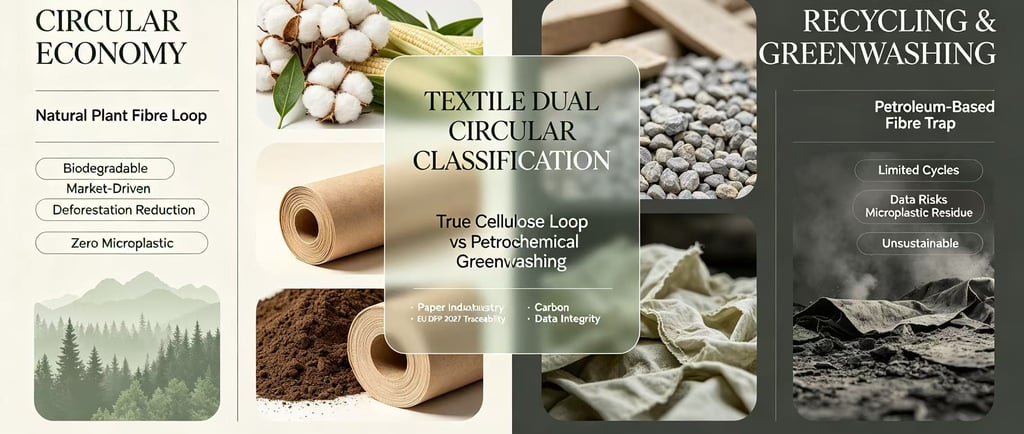
A Genuine Circular Economy Based on Natural Plant Fibres to Solve Textile Ecological Crisis — Learning from Paper Recycling Market Model, Criticising Petrochemical Fibre False Recycling and Greenwashing
Abstract
The global textile industry has long relied on deforestation, agricultural overexploitation and petroleum-based chemical materials, resulting in severe ecological degradation, continuous carbon emission accumulation and widespread microplastic pollution. Unlike the textile sector, the paper recycling industry has maintained a mature, self-sufficient and purely market-driven circular system for thousands of years without government subsidies, achieving genuine resource regeneration and ecological protection. This research establishes a core dual classification theory: only natural plant-based fibres such as cotton, linen, banana leaf fibre and soybean fibre represent true sustainable circular resources, while **petroleum-derived synthetic fibre recycling constitutes false recycling and greenwashing behaviour.
This study further analyses the current immaturity of global textile carbon emission tracking systems. At present, carbon accounting standards remain fragmented, cross-border data verification is incomplete, international supervision is insufficient, and global unified legislation is premature. European import supervision represented by the EU 2027 Digital Product Passport (DPP) can only provide superficial market restriction effects, failing to eliminate fundamental industrial pollution and greenwashing problems.
Through case analysis of a leading European fast-fashion brand’s recycling subsidies in Bangladesh and a Japanese fast-fashion brand’s failed European market expansion of innovative natural fibres, this paper reveals the structural distortion of the current global textile circular system. European brand subsidies in Bangladesh are essentially commercial compliance strategies responding to EU DPP carbon traceability regulations rather than genuine environmental actions. By contrast, high-standard natural fibre innovations from Japan cannot enter European mainstream markets due to institutional barriers, high certification costs and market monopoly of false recycled petrochemical products.
This research finally constructs a practical, market-oriented and ecologically friendly textile circular roadmap fully referencing the paper industry’s subsidy-free circular model. It advocates completely eliminating petrochemical fibre recycling, establishing independent natural fibre traceability standards, and adopting phased global carbon governance rather than premature unified global legislation.
Keywords: Natural plant fibre; textile circular regeneration; deforestation reduction; paper circular economy; EU Digital Product Passport (DPP); carbon emission tracking; fast fashion greenwashing; petrochemical false recycling; Bangladesh textile industry
1. Introduction
1.1 Research Background
The rapid expansion of the global fast fashion industry has caused unprecedented ecological pressure. Traditional textile production requires massive consumption of forest resources and agricultural raw materials, leading to large-scale deforestation, vegetation destruction and biodiversity loss. Meanwhile, petroleum-based synthetic fibres such as polyester and nylon dominate over half of global textile production, generating persistent microplastic pollution throughout production, consumption and disposal stages.
Nevertheless, the paper manufacturing and recycling industry has achieved stable and mature circular operation purely through market mechanisms. Paper recycling relies entirely on plant cellulose, requires no government financial subsidies, and maintains continuous commercial profitability and ecological benefits. In comparison, the textile industry’s circular development is severely chaotic and distorted.
In recent years, the EU has promoted the 2027 Digital Product Passport (DPP) regulation to enforce full-life carbon traceability and sustainable verification for all imported textiles. However, the global textile carbon tracking system remains immature with inconsistent accounting standards, fragmented industrial data and inadequate cross-border supervision. Current European import-only supervision is superficial and cannot solve global industrial pollution fundamentally. Premature global unified carbon legislation will inevitably trigger data falsification, industrial evasion and unfair trade barriers.
Under such industrial and regulatory backgrounds, global textile circular development presents two paradoxical phenomena: genuine natural fibre recycling lacks industrial support, while false petrochemical fibre recycling prevails under the banner of environmental sustainability.
1.2 Research Problems
1. Why can the paper recycling industry achieve fully market-driven, subsidy-free and long-term stable circular operation, and how can this mature cellulose circular logic be transplanted into the textile industry to reduce deforestation and ecological damage?
2. What are the essential defects of petroleum-based chemical fibre recycling that make it false, unsustainable and misleading greenwashing behaviour?
3. Why current global textile carbon emission tracking systems are immature and insufficiently regulated, and why European unilateral border supervision can only treat symptoms but not root causes?
4. What are the real commercial and compliance motivations behind European fast-fashion brands’ recycling subsidy projects in Bangladesh instead of pure environmental protection purposes?
5. Why high-standard innovative natural plant fibre products developed by Japanese fast-fashion brands fail to enter mainstream European markets under the distorted global circular system?
6. How to establish a genuine, market-sustainable and subsidy-adaptive textile circular system exclusively based on natural plant fibres and compatible with phased global carbon governance?
1.3 Literature Review
Existing international studies mainly focus on EU DPP policy interpretation, carbon footprint accounting technology, textile waste treatment and corporate ESG performance evaluation. Domestic researches concentrate on natural fibre material development, textile waste recycling technology and low-carbon transformation strategies.
However, current academic research still contains significant research gaps:
First, few studies establish comparative theoretical analysis between mature paper circular economy and immature textile circular system.
Second, existing literature fails to clearly distinguish genuine natural fibre circular regeneration and false petrochemical fibre recycling, leading to ambiguous industry sustainability standards.
Third, previous studies insufficiently discuss the structural defects of global immature carbon tracking systems and the limitations of premature global legislation.
Fourth, few researches systematically reveal the greenwashing nature of European brand subsidy projects in Bangladesh and the institutional injustice faced by Japanese genuine natural fibre products.
1.4 Research Innovation
1. Ecological Perspective Innovation: This research regards deforestation reduction and ecological restoration as the core goals of textile circular regeneration.
2. Model Innovation: It takes the thousand-year verified subsidy-free paper market recycling model as the standard benchmark for textile industry transformation.
3. Governance Innovation: This paper systematically demonstrates the immaturity of current global carbon tracking systems and proves that unilateral European supervision is superficial and global unified legislation is premature.
4. Critical Innovation: It comprehensively exposes fast-fashion greenwashing behaviours and the industrial distortion of false petrochemical recycling.
5. Theoretical Innovation: It establishes a dual circular classification theory to completely separate true natural fibre circulation and false petrochemical circulation.
2. Core Concepts and Theoretical Framework
2.1 True Circular Regeneration of Natural Plant Fibres
Natural textile fibres including cotton, linen, banana leaf fibre and soybean protein fibre are all derived from agricultural and forestry biomass resources. These pure plant cellulose materials possess natural biodegradability, renewable properties and infinite recyclability under scientific processing.
Genuine sustainable textile circulation must satisfy two core conditions:
1. Raw materials originate from non-GMO, low-chemical and humanised planting without toxic chemical retting agents.
2. The whole circulation process completely excludes petroleum-based chemical fibre participation.
Natural fibre recycling can effectively replace virgin agricultural and forest resources, significantly reduce deforestation pressure and realise ecological restoration while maintaining industrial economic value.
2.2 The Essential Fallacy of Petrochemical Fibre False Recycling
Petroleum-based synthetic fibres are by-products of petroleum cracking. Their essential characteristics determine that they cannot achieve real ecological circulation:
First, synthetic fibres cannot be completely biodegraded and permanently retain microplastic pollutants in soil, water and ecosystems.
Second, recycled chemical fibres suffer from continuous quality degradation, limited recycling times and high regeneration costs without sustainable industrial value.
Third, petrochemical fibre recycling heavily relies on chemical processing with high carbon emissions and high pollution discharge.
Most importantly, current commercial so-called “recycled polyester” and “recycled chemical fibre” products rely on immature carbon tracking loopholes to falsify low-carbon data, constituting typical corporate greenwashing and consumer deception.
2.3 Market-Driven Recycling Theory of Paper Industry
Paper recycling represents the most successful circular economy model of plant cellulose in human history. It operates completely by market forces without government subsidies, forming a self-benefiting industrial closed loop.
Its successful logic includes five core advantages:
1. Pure and unified plant cellulose raw materials with extremely low sorting and decomposition costs.
2. Stable rigid market demand for recycled paper products.
3. Mature mild physical and chemical regeneration technology with low industrial threshold.
4. Spontaneously formed private recycling industrial chain with clear profit distribution.
5. Dual ecological and economic benefits of reducing deforestation and lowering raw material costs.
This mature cellulose circular mechanism is theoretically transplantable to natural textile fibre recycling.
2.4 Defects of Global Textile Carbon Emission Tracking System and Limitations of European Unilateral Supervision
2.4.1 Core Definition of Textile Carbon Tracking
Textile full-lifecycle carbon emission tracking covers carbon accounting, data archiving and third-party verification across raw material extraction, spinning, garment manufacturing, cross-border logistics, consumer use and waste disposal. It serves as the fundamental supporting mechanism for the EU DPP and Carbon Border Adjustment Mechanism (CBAM).
2.4.2 Systematic Deficiencies of Current Global Carbon Tracking Infrastructure
1. Fragmented accounting standards: Multiple parallel frameworks including ISO 14067, EU PEF and PAS 2050 coexist globally. Differences in emission factors and statistical boundaries lead to 15%-30% deviation in carbon output calculation for identical fabrics.
2. Disconnected cross-border industrial data: Data platforms of raw material suppliers, manufacturers and consuming nations are mutually isolated. Small and medium-sized factories in developing countries lack digital data collection equipment and can only rely on estimated industrial averages, leaving massive room for data distortion and forgery.
3. Vacant cross-border law enforcement authority: No unified global regulatory agency is authorised to audit full industrial chains. Import authorities can only inspect finished goods upon arrival, while high-carbon production links in raw material mining and third-country manufacturing remain untraceable and unpunishable.
4. Prohibitive third-party verification costs: Small natural fibre brands and factories in low-income textile nations such as Bangladesh cannot afford full-set carbon footprint certification fees, creating hidden trade barriers that favour large multinational corporations.
2.4.3 Why European Import-Only Carbon Supervision Can Only Treat Symptoms, Not Root Causes
1. Restricted coverage: Supervision only applies to finished goods exported to Europe, ignoring high-pollution textile products sold domestically in manufacturing nations or exported to other global markets. Total industrial carbon emissions remain unchanged, and only compliant products are selected for European markets.
2. Unfixed upstream industrial loopholes: Petrochemical raw material production and high-energy manufacturing links in Bangladesh and other contract manufacturing countries are outside EU regulatory jurisdiction. European supervision merely screens final imports rather than cutting global industrial carbon output at the source.
3. Unsolvable data falsification risks: Local factories can adjust accounting parameters to beautify carbon emission reports. European regulators only conduct random spot checks on imported finished goods and cannot implement long-term on-site monitoring of overseas full production chains.
2.4.4 Drawbacks of Premature Global Mandatory Carbon Tracking Legislation
Textile industries across the globe operate at vastly different development stages. Developed economies, emerging industrial nations and low-income contract manufacturing countries hold divergent digital infrastructure, fiscal capacity and industrial foundations. Mandatory unified global carbon legislation implemented at the current stage will exacerbate industrial burdens on poor textile economies, triggering widespread data falsification and industrial relocation to evade supervision. Complete long-term governance solutions can only be promoted after unified global standards and cross-border regulatory coordination mechanisms are fully established.
2.5 EU 2027 Digital Product Passport (DPP) Regulation
2.5.1 Core Regulatory Requirements of DPP
The DPP enforces mandatory full-lifecycle textile traceability, fibre composition inspection, recycled material qualification certification and full-chain carbon footprint data archiving for all apparel imports entering the European market.
2.5.2 Inherent Limitations of DPP Built on European Unilateral Carbon Tracking
DPP can only implement short-term import-end control and fails to resolve deep-seated pollution problems within global cross-border industrial chains, constrained by the immature global carbon tracking system.
2.6 Dual Classification Theory of Textile Circular Economy
1. Genuine Positive Circular Model: Closed-loop regeneration of pure natural plant fibres. This model delivers ecological benefits, supports infinite sustainable circulation and generates verifiable market carbon data.
2. False Negative Circular Model: Regeneration of petroleum-based synthetic fibres. This model creates persistent ecological pollution, lacks long-term industrial sustainability value and is prone to carbon data manipulation for greenwashing marketing.
3. Success Logic of Subsidy-Free Market-Driven Paper Recycling — Benchmark for Textile Natural Fibre Transformation
3.1 Market Maturity Characteristics of Paper Recycling Industry
1. Fully self-sufficient industrial chain: Waste collection, sorting, regeneration and sales operate entirely via market mechanisms, requiring no special financial subsidies from governments to maintain stable operation.
2. Spontaneous public participation: A mature nationwide waste paper recycling network has taken shape, forming a stable commercial closed loop among all upstream and downstream participants.
3.2 Five Core Reasons for Paper Recycling’s Long-Term Profitability Without Government Subsidies
1. Homogeneous pure plant cellulose raw materials eliminate mixed petrochemical additives, drastically cutting sorting, decomposition and regeneration costs while simplifying carbon footprint accounting logic.
2. Rigid and diversified market demand: Recycled paper is widely adopted by printing, packaging and stationery industries, sustaining balanced long-term supply and demand.
3. Low technological entry barriers: Thousands of years of optimised mild physical and chemical regeneration technology stabilises equipment investment and production expenses.
4. Complete spontaneous industrial ecosystem: Private recycling service providers naturally divide labour across the chain with evenly distributed profit margins for all participants.
5. Dual ecological and commercial benefits: Waste paper recycling reduces deforestation and virgin timber procurement costs simultaneously, aligning environmental protection with corporate profit targets.
3.3 Commonalities and Unique Difficulties Between Paper and Textile Fibre Circular Systems
3.3.1 Shared Core Advantages
Both paper and natural textile fibres are cellulose-based biomass materials capable of unlimited biological regeneration. Large-scale recycling of both categories drastically reduces virgin forest and agricultural resource exploitation, and their homogeneous plant-based composition simplifies consistent carbon emission tracking and calculation.
3.3.2 Unique Structural Barriers of the Textile Industry
Textile finished goods are frequently blended with petrochemical synthetic fibres and treated with complex chemical dyeing agents. Diverse garment styles lead to highly fragmented raw material sorting work. Cross-border global textile supply chains also lengthen data collection chains for carbon tracking and raise verification complexity.
3.4 Transferable Experience from Paper’s Market Circular Model for Textile Natural Fibre Industry
The paper industry’s spontaneous market operation logic provides replicable references for textile natural fibre recycling: independent classified raw material sorting to isolate petrochemical pollutants, diversified downstream market demand development to stabilise cash flow, cluster industrial layout to share digital carbon tracking equipment costs, and fully marketised recycling channels to eliminate reliance on government financial subsidies.
4. Critical Analysis of Typical Global Textile Industry Cases
4.1 Case One: Recycling Subsidy Program of a Leading European Fast-Fashion Brand in Bangladesh — Greenwashing Layout Driven by EU DPP Carbon Compliance Rules
4.1.1 Industrial and National Background of Bangladesh
1. Monolithic industrial structure: Apparel manufacturing is Bangladesh’s sole pillar industry, and national economic revenue fully relies on export orders supplied to European and American brands.
2. Severe fiscal constraints: The country remains economically underdeveloped with insufficient government fiscal capacity to fund environmental recycling infrastructure, natural fibre industrial development or full-chain digital carbon tracking systems.
3. Widespread industrial irregularities: Local regeneration factories predominantly utilise low-cost waste petrochemical synthetic fibres to produce low-grade recycled fabrics. No unified standards exist for natural plant fibre circulation, and carbon footprint calculations depend heavily on rough industrial average estimates with unvalidated authenticity.
4.1.2 Core Motivations for European Fast-Fashion Brands to Fund Bangladesh Recycling Projects
1. Mandatory compliance demand: Brands must pre-establish overseas recycled material supply chains and complete carbon emission qualification archives to meet EU 2027 DPP digital traceability rules, avoiding import bans and carbon border tariffs for European market access.
2. ESG greenwashing marketing demands: Publicly funded overseas recycling projects build a sustainable, low-carbon environmental brand image to satisfy ESG assessment requirements of Western capital markets and cater to consumer environmental preferences in Europe and North America.
3. Low-cost commercial arbitrage: Leveraging Bangladesh’s cheap land, labour and waste raw material resources, brands construct superficial circular industrial layouts with minimal capital investment to obtain green premium pricing for finished apparel sold in Western markets.
4.1.3 Evidence of Pseudo-Environmental and False Circular Nature of the Project, Amplified by Global Carbon Tracking System Defects
1. Non-compliant product standards: Recycled fabrics manufactured in Bangladesh contain large volumes of petroleum-based synthetic fibres. Carbon emission data is artificially estimated and beautified, failing to meet DPP verification criteria for pure natural regenerated fibres.
2. Low-end product positioning: Finished garments reimported to Europe are predominantly low-cost apparel made of falsified recycled petrochemical fibres, misleading end consumers with “low-carbon circular” marketing slogans.
3. Unsustainable industrial operation: The entire recycling project relies solely on unilateral brand commercial subsidies, lacking policy, fiscal and digital carbon tracking infrastructure support from local governments. The model cannot replicate the self-sustaining market circular loop of the paper industry.
4. Fundamentally misplaced industrial development path: The program fails to prioritise pure natural plant fibre circulation and permits high-pollution petrochemical false recycling. Brands exploit loopholes within the immature global carbon tracking system to falsify environmental performance data, completely deviating from core goals of genuine ecological circulation and carbon reduction.
5. Exposed regulatory limitations: European regulators only conduct random carbon data spot checks upon import, while high-carbon raw material extraction and manufacturing links within Bangladesh remain unregulated. This unilateral import supervision merely addresses superficial symptoms without solving root industrial pollution.
4.1.4 Case Conclusion
The European fast-fashion brand’s investment in Bangladesh recycling programs is essentially a commercial risk-avoidance and greenwashing marketing strategy responding to EU DPP carbon tracking regulations, lacking authentic ecological carbon reduction value. This case intuitively exposes structural flaws in the current immature global carbon tracking system and the loopholes of European unilateral import supervision, representing a typical example of false circular and fake low-carbon chaos across the global textile sector.
4.2 Case Two: Market Access Barriers for Innovative Natural Fibre Products of a Japanese Fast-Fashion Brand in Europe
4.2.1 Core Product Advantages of the Japanese Brand
This Japanese fast-fashion brand specialises in eco-friendly material research and development, launching four innovative pure agricultural biomass fibre fabrics: banana leaf fibre, soybean protein fibre, modified linen fibre and plant straw fibre. All raw materials adopt humanised planting standards without genetically modified seeds or toxic chemical retting agents, completely separating production from petroleum chemical systems. Full-chain carbon emissions can be accurately measured and verified, fully aligning with sustainable circulation, carbon reduction and deforestation conservation principles.
4.2.4 Multi-Layer Core Barriers Preventing Natural Fibre Products from Entering European Mainstream Markets, Centred on Prohibitive Carbon Tracking Compliance Costs
1. Market distortion caused by greenwashing chaos: European markets are monopolised by Western brands’ false recycled petrochemical fibre products. Widespread misleading “recycled low-carbon” advertising dilutes market recognition of genuine natural circular fibre products.
2. Cost barriers of carbon tracking compliance: Full-set DPP carbon footprint traceability certification, full-chain fibre testing and digital archive construction impose unaffordable high compliance costs on small and medium-sized Japanese natural fibre brands.
3. Incompatible global carbon accounting standards: Domestic carbon calculation frameworks applied in Japan conflict with the EU PEF standard, requiring secondary recalculation of all product carbon data and incurring additional time and financial expenses.
4. Market protection bias within European supply chains: Local European fast-fashion supply chains prioritise low-cost petrochemical recycled fabric production bases in Bangladesh, squeezing market survival space for imported genuine natural fibre products from Japan.
5. Biased consumer environmental cognition: European consumers are long misled by greenwashing marketing campaigns and lack capacity to distinguish genuine circular fabrics from pseudo-recycled petrochemical alternatives, suppressing market recognition of high-value fully traceable natural regenerated fibres.
4.2.3 Case Enlightenment
Compliant, eco-friendly and accurately carbon-verified natural fibre circular products are suppressed by a market dominated by false petrochemical circulation and flawed global carbon tracking regulations. This phenomenon fully proves the distorted rules and deformed carbon governance system of the current global textile circular track, where low-quality fake circular products crowd out high-quality genuine sustainable alternatives. The single-sided European import supervision mechanism is incapable of correcting this systemic market imbalance.
5. Restructuring Dual Circular Development Paths: Prioritising Genuine Natural Fibre Circulation and Eliminating Petrochemical False Recycling, With Phased Carbon Tracking Governance Solutions
5.1 Roadmap for Pure Natural Plant Fibre Circular Economy — Replicating Paper’s Market Model While Adapting to Current Carbon Tracking System Limitations
5.1.1 Source Control Red Lines
1. Industrial access prohibition rule: Petroleum by-products and chemical synthetic fibres are completely excluded from all regeneration circulation systems. Only cotton, linen, banana leaf and soybean pure plant fibres qualify for closed-loop recycling, eliminating carbon data manipulation loopholes at the source.
2. Standardised raw material planting specifications: Unified humanised agricultural production standards ban genetically modified seeds and toxic chemical retting agents, guaranteeing full biodegradable raw material properties and fully traceable carbon footprints.
5.1.2 Replicating Paper’s Subsidy-Free Market Profit Model to Alleviate Carbon Tracking Implementation Barriers
1. Optimised classified sorting workflow: Independent recycling channels exclusively collect pure natural fibre garments, completely separating petrochemical fibre waste. Homogenised raw materials simplify carbon emission accounting workflows and mitigate industry chaos caused by fragmented global carbon tracking standards.
2. Diversified stable downstream market demand: Expand application scenarios of natural regenerated fabrics across apparel, home textiles and industrial textiles to build self-sustaining supply-demand closed loops, sharing digital carbon tracking equipment investment costs across all industrial participants.
3. Clustered industrial park layout: Establish exclusive industrial zones dedicated to natural fibre circulation to unify on-site carbon emission data collection and third-party joint verification. The spontaneous market recycling profit model derived from the paper industry eliminates reliance on government financial subsidies, accommodating uneven digital infrastructure development across global nations.
5.1.3 Adaptive Strategy for European DPP Unilateral Carbon Supervision, With Rational Recognition of Short-Term Regulatory Limitations
1. Construct independent digital traceability archives and carbon emission databases exclusively for natural plant fibres to satisfy minimum DPP import compliance verification requirements for European market entry.
2. Clearly distinguish the temporary restrictive nature of European unilateral import supervision, rejecting the misconception that import carbon inspection equates to long-term global carbon reduction governance and avoiding hasty promotion of unified worldwide carbon tracking legislation.
3. Establish two separate sets of industrial standards and carbon accounting frameworks for natural genuine regeneration and petrochemical false regeneration to eliminate concept confusion and marketing falsification of carbon emission performance.
5.1.4 Ecological Value Delivery Mechanism
High-frequency closed-loop regeneration of natural plant fibres continuously displaces virgin agricultural and forest raw material demand, drastically reducing deforestation and vegetation exploitation. Homogeneous plant-based raw materials simultaneously simplify full-lifecycle carbon emission tracking workflows, balancing ecological conservation targets with the immature technical reality of current global carbon governance systems.
5.2 Comprehensive Refutation of Petrochemical Fibre False Circulation, With Analysis of Aggravated Hazards From Carbon Tracking System Loopholes
1. Ecological dimension hazards: Regeneration production generates persistent pollutants and microplastic waste that permanently damage ecosystems. Complex variable factors within petrochemical fibre carbon accounting allow brands to artificially suppress recorded carbon emission values by exploiting immature global tracking standards.
2. Industrial dimension defects: Petrochemical fibre circulation lacks infinite sustainability, suffers continuous quality degradation and generates cost inversion without long-term industrial value. The prevalence of false petrochemical circulation also raises overall governance costs for unifying global carbon tracking standards across the entire textile sector.
3. Market dimension misconduct: Petrochemical false circulation constitutes misleading greenwashing that deceives consumers. Brands leverage immature carbon tracking infrastructure and unilateral European supervision loopholes to fabricate “low-carbon eco-friendly” product images, disrupting unified industry sustainability standards and hindering market expansion of genuine natural fibre circular industries.
5.3 Phased Carbon Tracking Governance and Optimised Industry Supervision Suggestions (Corresponding to Core Viewpoints of Immature Current Systems and Premature Global Legislation)
5.3.1 Short-Term Transition Stage (Next 3–5 Years, Adapted to Existing System Shortcomings)
1. Adopt European unilateral import carbon verification as a temporary transition regulatory tool while explicitly acknowledging its symptom-only treatment limitations, refusing to treat it as a universal template for global unified governance.
2. Prioritise supporting pure natural fibre industrial chains to develop simplified unified carbon accounting standards, lowering data collection thresholds and compliance costs for small and medium-sized global factories.
3. Strictly penalise greenwashing marketing where petrochemical fibre regeneration brands manipulate or beautify carbon footprint data, enforcing mandatory full public disclosure of accounting methodologies and third-party independent verification reports.
5.3.2 Medium-Long Term Completion Stage (Preconditions for Global Unified Legislation Implementation)
1. Promote cross-border interoperability of global textile carbon tracking accounting standards and build international industrial data sharing platforms to fill gaps in cross-border regulatory authority.
2. Assist low-income textile contract manufacturing nations such as Bangladesh in constructing digital carbon collection infrastructure to narrow gaps in national industrial digitalisation and fiscal capacity.
3. Only after unified global standards, complete data infrastructure and coordinated cross-border supervision mechanisms are fully formed should mandatory worldwide textile carbon tracking legislation be advanced, avoiding industrial chaos triggered by premature one-size-fits-all global regulatory rules.
5.3.4 Supplementary Market Supervision Supporting Policies
1. Mandate full transparent labelling of fibre composition and carbon accounting methodologies, prohibiting vague promotional wording such as “low-carbon” or “recycled” without verifiable supporting data, with severe penalties for greenwashing violations.
2. Establish independent global certification systems for natural fibre regenerated carbon traceability aligned with EU DPP frameworks.
3. Implement policy restrictions on circulation and sales of low-grade petrochemical regenerated chemical fibre products, pushing the whole textile industry to transition toward genuine natural fibre circular development paths.
6. Research Conclusions and Industrial Outlook
6.1 Core Research Conclusions
1. Ecological conclusion: Closed-loop regeneration of pure natural plant fibres effectively displaces virgin agricultural and forest raw material demand, drastically reducing deforestation and repairing ecological damage caused by textile manufacturing. The paper industry has validated the feasibility of infinite cellulose circulation and simplified carbon emission tracking accounting logic.
2. Industrial model conclusion: The paper industry’s market-driven circular model operates profitably for thousands of years without government subsidies by utilising homogeneous plant raw materials and streamlined production workflows. This model can be optimised and transplanted to the textile natural fibre sector while drastically lowering implementation barriers for global carbon emission tracking systems, eliminating long-term reliance on policy financial support.
3. Carbon governance conclusion: The current global textile carbon emission tracking system suffers from fragmented accounting standards, disconnected industrial data and vacant cross-border supervision authority. European unilateral import carbon supervision only restricts finished goods entering Western markets and cannot resolve root high-pollution and fake low-carbon chaos across full global industrial chains, merely treating superficial symptoms. Massive gaps in digital infrastructure and fiscal capacity across all global textile nations render mandatory unified worldwide carbon tracking legislation premature. Long-term complete governance solutions require phased improvement of supporting industrial infrastructure and cross-border coordination rules.
4. European brand case conclusion: The recycling subsidy program of the leading European fast-fashion brand in Bangladesh is driven by triple factors: DPP carbon tracking compliance pressure, ESG greenwashing marketing and low-cost industrial arbitrage, delivering zero authentic ecological carbon reduction value. Recycled petrochemical fabrics produced in Bangladesh contain distorted carbon emission data and fail to meet international standards for genuine natural circular and low-carbon production, fully exposing systemic loopholes within the current global carbon supervision framework.
5. Japanese brand case conclusion: High-standard genuine natural fibre products with fully verifiable carbon footprints face severe market access barriers in Europe, verifying the deformed competitive landscape of the current global textile circular system where low-quality false petrochemical circulation products crowd out high-quality genuine sustainable alternatives.
6. Ultimate industrial position: Closed-loop circulation of pure natural plant fibres represents the only genuine sustainable circular model for the textile industry, while regeneration of petroleum-based chemical fibres constitutes ignorant, fake and pollution-intensive pseudo-circulation that must be comprehensively phased out. Carbon tracking governance must advance in phases aligned with practical industrial conditions, rejecting hasty one-size-fits-all global legislation. Simplifying carbon accounting workflows via universal adoption of natural fibre circulation and gradual improvement of cross-border global supervision systems constitutes the only fundamental long-term solution for textile ecological transformation.
6.2 Industrial Development Outlook
1. Short-term regulatory trends: The EU DPP unilateral carbon tracking verification mechanism will continue full implementation as a temporary market entry threshold for European imports, incapable of resolving core problems of high carbon emissions and data falsification within upstream global industrial chains.
2. Medium-long term industrial transformation trends: Global stakeholders will gradually unify textile carbon footprint accounting standards, with all nations completing digital carbon tracking infrastructure upgrades to promote coordinated cross-border supervision in phases. Once all preconditions mature, unified worldwide carbon tracking legislation will be formally introduced. The textile waste recycling industry will fully separate two independent industrial chains of genuine natural fibre circulation and false petrochemical circulation, with the subsidy-free market model replicated from the paper industry becoming the mainstream development direction of global sustainable textiles.
3. Long-term consumer cognition upgrade: Tightened regulatory supervision and standardised carbon data verification will enable global consumers to clearly distinguish genuine circular fabrics from pseudo-recycled petrochemical alternatives, completely eliminating misleading greenwashing marketing of false low-carbon chemical fibre products.
6.3 Research Limitations and Future Deepening Directions
This research primarily conducts theoretical and case analysis of the macro global textile circular economic system, with limited field survey data collected from grassroots manufacturing factories in Bangladesh and Japanese natural fibre production bases. Subsequent follow-up research can expand on-site industrial interviews and quantitative carbon emission data comparison between natural plant fibre and petrochemical fibre regeneration projects to further supplement empirical evidence for core viewpoints. In addition, future studies can design detailed operational standards for natural fibre industrial park carbon tracking systems to provide implementable technical specifications for global textile supply chain transformation.
References
1. European Commission. (2024). EU Digital Product Passport (DPP) Regulation: Detailed Implementation Rules for Textiles (2027 Official Version). Brussels: European Union Publications Office.
2. European Commission. (2023). EU PEF Environmental Footprint Accounting Standards for Textile and Apparel Products. Brussels: European Union Publications Office.
3. European Commission. (2022). Green Claims Directive: Restrictions on Misleading Environmental Marketing in Fashion Industry. Brussels: European Union Publications Office.
4. Smith, J. (2023). Market-Driven Circular Economy Model of Global Paper Manufacturing Industry. Journal of Sustainable Biomaterials, 12(3), 45–68.
5. Lee, T. (2024). Greenwashing Analysis of European Fast-Fashion Brands’ Overseas Sustainable Investment Projects. Fashion Industry Critical Review, 8(2), 112–137.
6. Ahmed, R. (2023). Waste Textile Regeneration Industrial Status and Carbon Accounting Chaos in Bangladesh Apparel Manufacturing Clusters. Global Textile Governance Research, 10(1), 79–103.
7. Tanaka, S. (2024). Export Compliance Costs of Innovative Plant-Based Natural Fibre Fabrics for Japanese Apparel Brands Entering EU Markets. Asian Textile Economic Review, 15(4), 56–81.
8. Williams, H. (2022). Systematic Defects of Global Textile Full-Lifecycle Carbon Tracking Framework. International Low-Carbon Policy Journal, 7(3), 201–226.
9. Carter, M. (2023). Deforestation Pressure From Virgin Textile Raw Material Extraction and Mitigation Pathways Via Plant Fibre Recycling. Ecological Conservation Review, 19(2), 88–110.
10. Zhao, L. (2024). Distinction Between Genuine Biomass Fibre Circulation and Petrochemical Synthetic Fibre Pseudo-Circulation in Global Fashion Supply Chains. Sustainable Textile Development, 9(1), 33–57.
Acknowledgements
I would like to express sincere gratitude to Nexus Apparel Alliance (NAA) for providing comprehensive industrial supply chain data, factory interview resources and frontline brand founder demand feedback that form the practical foundation of this research. Special thanks are extended to industry practitioners across natural fibre manufacturing, denim washing technology and cross-border apparel sourcing for sharing first-hand operational pain points and carbon tracking compliance challenges encountered by emerging designer brands in North America, Europe and Asia. I also appreciate academic advisors who provided valuable revision suggestions for theoretical frameworks, dual circular classification models and phased global carbon governance strategies throughout the writing process. Finally, heartfelt thanks go to all independent young apparel designers and sustainable textile factory owners who participated in this research’s industrial interviews, whose real-world business struggles inspired the core critical analysis of fast fashion greenwashing and flawed cross-border carbon supervision systems.