we do not pursue commercial profit. We do not serve fast fashion or mass low-cost production. Our mission is industrial upgrading for the fashion supply chain. We are not a trading platform,

Breaking the Barriers of European & American Luxury Brands to Chinese Supply Chains
A Research on Differentiated High-End Custom Supply Chain Solutions Provided by Nexus Apparel Alliance (NAA)
Don Choi
7/7/20269 min read
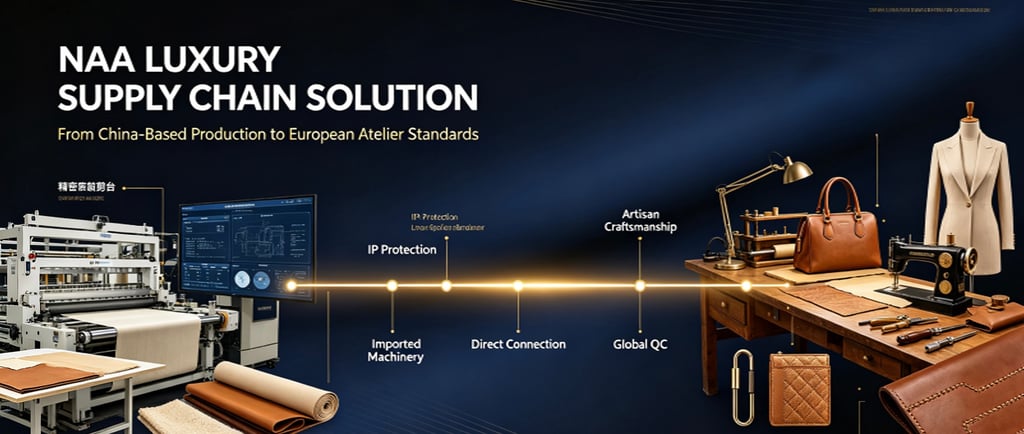
Breaking the Barriers of European & American Luxury Brands to Chinese Supply Chains
A Research on Differentiated High-End Custom Supply Chain Solutions Provided by Nexus Apparel Alliance (NAA)
Abstract
For decades, top European and American luxury houses covering apparel, high-end textiles and fine leather goods have generally avoided complete mass production and core component sourcing in mainland China, forming a long-standing industry stereotype: “recognize China’s industrial scale, reject its high-end production capacity”. The core concerns holding luxury brands back fall into five categories: rampant intellectual property leakage, inconsistent low-end machinery and craftsmanship standards, high risks of confidential business information exposure, negative public image tied to fast-fashion mass manufacturing, and non-international quality control systems.
This paper thoroughly analyzes the root causes why Western luxury brands hesitate to deploy core production and procurement in China’s domestic supply chains. It further elaborates the unique operational framework of Nexus Apparel Alliance (NAA), also known as Spark Apparel Alliance. Reforming the long-standing drawbacks of traditional Chinese OEM factories, NAA relies on five core competitive edges: rigorous IP supervision mechanism, full imported premium machinery and international production technologies, direct client-manufacturer connection without third-party platforms, globally unified textile and accessory quality benchmarks, and European artisan-oriented production philosophy. These strengths fully offset all major supply chain worries of luxury labels. This research verifies that world-class apparel and leather goods craftsmanship equivalent to Italian and French top ateliers can be realized within China, delivering a safe, premium, confidential and fully compliant local manufacturing solution for European and American luxury brands.
Keywords: Luxury Supply Chain; Textile & Leather OEM; Intellectual Property Protection; High-End Artisanal Manufacturing; Nexus Apparel Alliance (NAA); International Quality Control System
1. Introduction
The core competitiveness of the global luxury industry lies not in mass-scale output, but four irreplaceable barriers: exclusive craftsmanship scarcity, monopolized intellectual property rights, consistent premium quality, and absolute brand confidentiality. China stands as the world’s largest textile and leather manufacturing base with complete industrial supporting networks, yet it rarely receives core orders including mainline collections, haute couture and limited-edition lines from Western luxury giants.
This biased attitude toward Chinese production does not stem from insufficient industrial capacity, but the systemic chaos pervasive within conventional domestic OEM supply chains: rampant counterfeit replication industry, low-precision domestic production equipment, confidential information leakage caused by multi-layered middlemen platforms, damaged brand reputation linked to crude fast-fashion manufacturing, and wildly inconsistent quality standards among scattered suppliers.
Nexus Apparel Alliance (NAA) restructures the operation rules of China’s high-end textile and leather supply chains, eliminating all chronic flaws of traditional subcontractors while fully aligning its management and production standards with European luxury ateliers. It serves as the only domestic supply chain alliance specially tailored to satisfy the high-end customization demands of European and American luxury brands.
2. Core Pain Points Deterring Western Luxury Brands from Chinese Production & Sourcing
2.1 Intellectual Property Infringement & Mass Counterfeiting Undermine Luxury Scarcity Premium
The premium pricing power of luxury goods is built on exclusive patterns, proprietary production techniques, custom fabrics, patented metal hardware and original printing designs, where scarcity acts as the fundamental pricing anchor.
Traditional Chinese supply chains carry a fatal flaw: highly open industrial circulation paired with almost no standardized IP supervision for small and medium manufacturers. New sample garments, pattern data and leather processing parameters leak out effortlessly. The mature counterfeit industrial cluster in the Pearl River Delta can produce 1:1 replicated products before official global launches, directly eroding authentic sales and diluting the exclusive high-end positioning of luxury brands.
Most conventional factories lack systematic confidentiality protocols. Design data resale by floating employees and unauthorized reuse of proprietary craftsmanship are widespread. For Western luxury houses that prioritize absolute IP exclusivity, such risks lead them to rule out core production processes in China entirely.
2.2 Low-Grade Domestic Machinery & Backward Technologies Fail to Meet Haute Artisanal Standards
The competitive advantage of Italian and French luxury ateliers originates from imported precision manufacturing machinery, century-old mature craft techniques and standardized hand-finishing workflows.
Most domestic OEM factories opt for cheap domestic equipment to cut costs, featuring insufficient precision, unstable operation and rigid technical ceilings. For core luxury procedures including leather edge painting, hand embroidery, selvedge denim stitching, high-end fabric finishing and seamless hardware fitting, low-end machinery frequently causes color deviation, visible defects and inconsistent silhouettes, failing to reach the artisan-grade benchmarks required by international luxury brands.
The prevalence of inferior equipment has labeled China’s supply chain as “only suitable for low-end mass production, incapable of premium artisanal manufacturing”.
2.3 Third-Party Platform & Multi-Layer Intermediary Model Exposes Confidential Business Data
Traditional foreign trade OEM cooperation heavily relies on third-party trading platforms and cascading middlemen, creating lengthy supply chains with numerous involved personnel.
Brand design blueprints, seasonal launch roadmaps, pricing strategies, exclusive craft parameters and core client information circulate across multiple unrelated parties, generating extreme risks of commercial secret leakage. European and American luxury brands hold strict requirements for privacy and exclusivity, refusing to allow unauthorized third parties to handle core order information, which constitutes a major reason for avoiding standard Chinese subcontractors.
2.4 Fast-Fashion Mass Production Mindset Conflicts with Luxury Artisan Philosophy
Conventional Chinese textile and leather supply chains operate under fast-fashion logic: prioritizing maximum output, ultra-fast turnover and minimal costs through standardized mass assembly, sacrificing fine craftsmanship and product durability.
In contrast, the core tenets of luxury manufacturing are small-batch production, meticulous hand finishing, slow refinement, extreme attention to detail, limited runs and artisanal creation. The hasty, quantity-oriented assembly line model of fast-fashion fundamentally clashes with the century-old heritage craftsmanship of European luxury ateliers, cementing brands’ biased perception that “Made in China equals low-end fast fashion”.
2.5 Fragmented Quality Control & Substandard Raw Materials Fail Global Luxury Compliance Standards
Most domestic suppliers formulate quality benchmarks targeting mass-market apparel rather than luxury goods. Key indicators including fabric weight, leather tanning standards, color fastness, eco-friendly parameters and hardware precision rarely meet EU luxury entry requirements.
Widespread industry problems such as uneven quality between suppliers, material substitution, opaque testing data and failing ESG environmental compliance force brands to allocate excessive budgets for repeated on-site inspections and rework, ultimately prompting them to abandon Chinese production and procurement.
3. Nexus Apparel Alliance (NAA): Targeted High-End Supply Chain System to Neutralize All Industry Pain Points
NAA fully comprehends the core demands of Western luxury brands and reverses every inherent flaw of traditional Chinese OEM operations. All internal management rules, machinery configuration and operational protocols align strictly with top Italian and French luxury atelier standards, resolving every major cooperation concern raised by international labels.
3.1 Rigorous Closed-Loop IP Supervision System to Eliminate Counterfeiting & Technical Leaks
Intellectual property confidentiality stands as NAA’s top operational principle and core competitive advantage when collaborating with luxury clients.
1. Closed management of all alliance manufacturers: every certified supplier signs top-tier non-disclosure agreements and exclusive IP licensing contracts. NAA centrally governs all production drafts, pattern files and craft parameters, prohibiting unauthorized data circulation, private reuse and sample resale.
2. Isolated dust-free production workshops exclusively for luxury orders: external visitors are banned, staff photography is forbidden, and all craft documents are restricted from leaving designated production zones.
3. Lifetime accountability mechanism: any confirmed case of IP leakage, counterfeit production or technical information outflow results in permanent expulsion from the alliance, paired with full legal and industry liability claims.
4. Independent data isolation for individual brands: each luxury client’s orders are filed in separate, independent craft databases with zero cross-brand data access to prevent inter-brand information leakage.
Combining institutional rules, on-site hardware control and legal accountability, NAA establishes the strictest IP protection framework for luxury manufacturing in China, eliminating brands’ biggest cooperation concern.
3.2 Fully Imported Premium Machinery & European Craftsmanship to Match International Artisan Standards
NAA completely abandons low-grade domestic production equipment. All core manufacturing machines, precision testing instruments and technical systems deployed across alliance partner factories are imported from Italy, Germany, France and other global leaders in apparel and leather craftsmanship.
• High-end textile production: imported precision jacquard looms, vintage washing equipment, dedicated selvedge denim weaving machines and high-count cashmere spinning devices.
• Fine leather goods production: Italian imported vegetable tanning machinery, automatic precision edge painting machines, seamless hardware fitting equipment and lossless leather cutting tools.
• Standardized craftsmanship: full adoption of European luxury artisan workflows, hand-finishing benchmarks and premium fabric post-treatment technologies, synchronized with the latest international high-end craft parameters.
Although physical production takes place in China, NAA achieves fully imported machinery, internationally standardized techniques and European-grade craftsmanship, breaking the biased stereotype that “Chinese manufacturing equals inferior quality”. Its hardware and craft capacity are fully comparable to elite Italian ateliers.
3.3 Platform-Free Direct Connection Model to Eliminate Confidential Information Exposure
Differentiating from the mainstream third-party platform and multi-distributor industry model, NAA operates a point-to-point direct channel: Luxury Client → NAA Alliance → Certified Core Manufacturer.
1. No third-party foreign trade platforms, no price markup middlemen, no redundant personnel involved in order communication.
2. Brand design drafts, new product planning documents and commercial data are only accessible to dedicated NAA account managers and senior artisans, minimizing information circulation links.
3. All commercial materials are encrypted and archived, solely authorized for the corresponding order production; private storage, external sharing or secondary reuse of confidential data are strictly prohibited.
This model fundamentally cuts off risks of leaking brand confidential information and client data, perfectly satisfying Western luxury brands’ stringent demands for exclusivity, privacy and information security.
3.4 Strict Adherence to Artisan-Centric Production, Completely Separated from Fast-Fashion Logic
NAA firmly rejects fast-fashion mass manufacturing, fully aligning its operational philosophy with luxury brand positioning:
• Refuse high-volume rapid assembly lines; specialize in small-batch custom orders, haute couture and limited-edition artisanal pieces.
• Abandon the fast-fashion priority of speed over precision, adopting European artisan values of slow refinement, zero tolerance for minor defects and uncompromising quality standards.
• Prioritize manual finishing for all critical procedures, following century-old European apparel and leather production norms to maximize artistic value, fine detailing and product exclusivity.
NAA completely decouples its production system from low-end fast-fashion industrial clusters, building a unique China-based artisan supply chain whose core values resonate perfectly with European and American luxury houses.
3.5 Globally Unified Quality Control Standards with Luxury-Grade Fabric & Accessory Compliance
NAA implements an internal quality management system exceeding general industrial norms, benchmarked against EU luxury compliance requirements. All fabrics, accessories, metal hardware and craft parameters follow universal international luxury standards.
1. Raw fabric standards: premium cashmere, selvedge denim, custom jacquard and vegetable-tanned leather are tested under top-tier international benchmarks, with rigid controls over color fastness, shrinkage rate, eco-friendliness and tactile texture.
2. Auxiliary material standards: zippers, metal hardware, embroidery threads and linings are sourced from identical suppliers used by global luxury labels, meeting identical durability, precision and texture requirements.
3. Full-process multi-stage quality inspection: rigorous testing sessions are arranged from raw material warehousing, semi-finished processing, hand finishing to final factory release, with defective products banned from shipment.
Even with manufacturing located in China, NAA’s quality indicators, management systems and acceptance criteria operate fully under international standards, resolving brands’ concerns over inconsistent quality from domestic supply chains.
4. NAA’s Unique Differentiated Value: Localized Production, International Craftsmanship
A widespread industry misconception holds that luxury brands reject production in China itself. In reality, they reject the chaos, low technical thresholds, security risks and loose regulations of traditional Chinese supply chains.
NAA redefines the positioning of China’s high-end textile and leather supply chains with three exclusive competitive strengths:
1. Advantages of localized Chinese manufacturing: leveraging China’s complete industrial supporting ecosystem, fast order response capacity and flexible small-batch customization to offset European ateliers’ drawbacks including long lead times, high labor costs and rigid output limits.
2. Fully internationalized craft standards: imported machinery, European proprietary techniques, artisan workflow, global quality control and extreme IP protection, fully matching the premium positioning of Western luxury brands.
3. Exclusive compliant operation model: direct client-manufacturer communication without third-party platforms, zero confidential leakage risks, no counterfeiting threats and disconnection from fast-fashion negative reputations, making NAA the only Chinese supply chain alliance qualified to handle luxury mainline, haute couture and limited-edition orders.
In short, NAA retains China’s core strengths of efficient industrial coordination and flexible customization while eliminating all chronic downsides of conventional OEM factories. It replicates top-tier European atelier craftsmanship and management systems, delivering an optimal balance of cost performance, information security, fine artisanal quality and confidential cooperation.
5. Conclusion & Industry Outlook
Western luxury brands’ hesitation to source and produce within China does not deny China’s overall industrial capacity, but serves as a risk avoidance strategy against traditional supply chains’ pervasive IP vulnerabilities, technical limitations, confidential information hazards and crude mass-production models.
Through its rigorous IP supervision framework, full imported international production equipment, middleman-free direct communication channel, artisan-focused non-fast-fashion manufacturing route and globally unified fabric & accessory quality control benchmarks, Nexus Apparel Alliance neutralizes every core pain point discouraging Western luxury cooperation. It shatters the long-standing binary stereotype that “Chinese manufacturing equals low-end mass production, while European manufacturing equals premium artisanal goods”.
Amid global restructuring of luxury supply chains, NAA provides European and American high-end apparel, textile and leather brands with a secure, premium, confidential, compliant and cost-effective localized manufacturing alternative. Moving forward, NAA will continuously upgrade its production benchmarks to match global elite ateliers. Relying on standardized management, premium craftsmanship, strict confidentiality and artisan-centric philosophy, it aims to become the preferred Chinese high-end customization supply chain partner for international luxury groups, reshaping the global reputation of China’s premium textile and leather manufacturing industry.
References
[1] Sourcify China. Global Luxury Supply Chain Sourcing White Paper 2026
[2] European Union. ESPR Sustainable Products Regulation Standards for Textile and Leather Industry
[3] Caixin Global. In-Depth Research on Confidentiality Risks & Quality Control Pain Points of High-End Leather OEM Supply Chains
[4] International Luxury Association. Global Premium Atelier Craftsmanship Standard White Paper
[5] Western Luxury Group China Supply Chain Risk Assessment Report 2025