we do not pursue commercial profit. We do not serve fast fashion or mass low-cost production. Our mission is industrial upgrading for the fashion supply chain. We are not a trading platform,

Platform Capitalism and the Hidden Crisis of Overstock Textile Waste in Cross-border Fast Fashion: Supplier Dilemmas, Liability Vacuum and Global Governance Countermeasures
Blog post description.
Don Choi
6/15/202614 min read

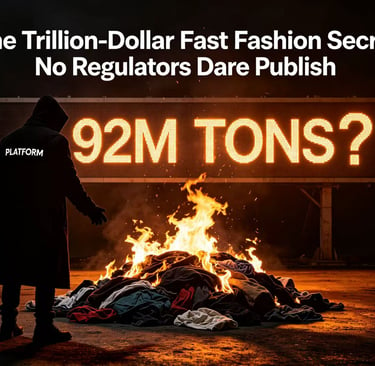
Platform Capitalism and the Hidden Crisis of Overstock Textile Waste in Cross-border Fast Fashion: Supplier Dilemmas, Liability Vacuum and Global Governance Countermeasures
Abstract
The global textile industry generates 92 million tons of textile waste annually. Existing academic and industrial research predominantly focuses on explicit waste stemming from post-consumption disposal, second-hand elimination and finished product scrapping. This paper identifies a critical research gap: cross-border e-commerce platforms including Amazon, TikTok Shop and SHEIN have given rise to large-scale untracked, unsold and unreported hidden overstock textile waste across global supply chains.
Distinct from conventional post-consumer textile waste, this emerging pollution is driven by structural factors: algorithm-led blind overproduction, unrestricted entry of global suppliers, homogeneous low-price competition, inefficient cross-border reverse logistics and stagnant inventory in overseas warehouses.
From the perspective of global apparel suppliers, this study analyzes how cross-border e-commerce reshapes production paradigms and triggers industrial plights and negative environmental externalities. It further dissects the liability vacuum for waste remediation, clarifying who creates, hoards, pays for and disposes of hidden textile waste. Special focus is placed on the Digital Product Passport (DPP), Transaction Certificate (TC) and full-lifecycle carbon emission tracking schemes scheduled for full enforcement in Europe and the United States in 2027. This paper reveals their practical functions, implementation paradoxes and underlying logic of shielding dominant e-commerce platforms, and evaluates their overall effectiveness.
Based on trend projections for 2026–2030, this paper proposes a set of systematic and implementable solutions covering international legislation, governmental supervision, platform reform and supply chain transformation, aiming to address the root causes of the hidden textile waste crisis and misaligned environmental liabilities.
Keywords: Cross-border e-commerce; Fast fashion; Textile waste; Overstock inventory; Extended Producer Responsibility (EPR); Digital Product Passport (DPP); Transaction Certificate (TC); Carbon footprint tracking; Platform capitalism; Supply chain involution
1. Introduction
1.1 Research Background
With the worldwide proliferation of social commerce and algorithm-driven e-commerce, traditional order-based international trade has been largely replaced by a new operational model characterized by data-oriented small-batch flexible production, predictive capacity planning and traffic-led manufacturing. Amazon defines bestsellers via global search data, TikTok Shop creates short-term consumption trends through short-video content, and SHEIN pushes its supply chain into hyper-frequent production with daily new product launches.
This business model has brought about two profound consequences. First, global apparel suppliers are trapped in a locked industrial state featured by barrier-free market access, perpetual low-price competition and excessive reliance on e-commerce platforms. Second, textile pollution has shifted from post-consumption waste to pre-consumption waste. Massive finished garments turn into industrial waste or long-term stagnant inventory even before reaching end consumers, due to poor sales, seasonal obsolescence, high return rates and inaccurate algorithmic predictions.
Against this backdrop, European and American authorities have successively rolled out regulatory instruments including DPP, TC and full-lifecycle carbon emission tracking since 2024, which are set for full implementation in 2027. Though branded as environmental governance tools for traceability and carbon reduction, these policies present obvious paradoxes in cross-border e-commerce ecosystems: uneven law enforcement, exemption of core liabilities for major platforms and excessive compliance pressure on suppliers. Their real purposes and operational outcomes have become a major puzzle for the global textile sector.
1.2 Research Gaps
Current environmental reports, sustainable textile studies and researches on the EU EPR framework have four prominent limitations:
1. Statistical frameworks only account for circulated and consumed textile waste, while completely ignoring hidden waste from unsold overstock.
2. Pollution liabilities are simply attributed to manufacturers, without examining structural driving forces such as platform rules, traffic mechanisms and cross-border institutional loopholes.
3. Comprehensive discussions on waste remediation mechanisms, liability allocation, cost-bearing rules, trend forecasting and fundamental solutions are insufficient.
4. In-depth interpretation of the 2027 DPP, TC and carbon tracking policies is lacking. Most studies misinterpret these schemes as pure environmental governance tools, while overlooking their double standards and platform-protection tendencies.
1.3 Research Objectives
1. Explain why global apparel suppliers cannot withdraw from cross-border e-commerce and are forced to continuously produce low-cost surplus goods.
2. Reveal the formation mechanism and expanding risks of hidden overstock textile waste worldwide.
3. Clarify the widespread liability vacuum for waste remediation and the ambiguous division of responsibilities among stakeholders.
4. Analyze the actual functions, implementation dilemmas and effectiveness of the 2027 DPP, TC and carbon emission tracking regulations in Europe and North America.
5. Forecast industrial and pollution trends from 2026 to 2030.
6. Put forward multi-dimensional solutions for international organizations, governments, e-commerce platforms, brands and suppliers.
2. Restructuring of Global Apparel Supply Chains by International E-commerce Platforms: Empowerment and Industrial Lock-in
2.1 Platform Empowerment: Low-barrier Global Expansion for Suppliers
Compared with traditional international trade that relies on exhibitions and long-term OEM contracts with strict entry thresholds, Amazon, TikTok Shop and SHEIN provide a low-cost global distribution channel:
• Borderless traffic enables suppliers to reach end consumers across Europe, America, Southeast Asia and the Middle East.
• Real-time trend data generated by platform algorithms cuts down R&D and trial-and-error costs.
• Integrated cross-border logistics, overseas warehousing, customs declaration and tax agency services greatly lower the entry barriers for small and medium-sized manufacturers engaged in overseas trade.
Over the past decade, numerous small and medium-sized garment factories in China, Bangladesh, Vietnam and Cambodia have transformed from pure OEM producers into cross-border sellers, accompanied by rapid expansion of production capacity.
2.2 Structural Lock-in: Why Suppliers Cannot Break Away from Platform Dependence
For most global apparel suppliers, reliance on international e-commerce platforms is not a voluntary business choice, but a matter of survival:
1. The customer acquisition cost of operating independent websites is far higher than platform advertising expenditure.
2. Traditional bulk international orders continue to shrink, and orders become increasingly fragmented.
3. Most suppliers lack independent brand recognition, private domain customer resources and capabilities for localized overseas operation.
4. Platform settlement mechanisms offer more stable capital cycles compared with long account periods from traditional overseas clients.
This has formed an irreversible industrial trend: new suppliers keep entering the market, existing players dare not exit, and global production capacity remains in surplus.
3. Deep-seated Dilemmas of Apparel Suppliers under Cross-border E-commerce Frameworks
3.1 Global Homogeneous Involution: Forced Overproduction Driven by Low-price Competition
International e-commerce platforms set product price, new product launch frequency and delivery speed as core indicators for traffic distribution.. New entrants adopt low-quality and low-price strategies to quickly gain market exposure, while incumbent suppliers follow suit to retain existing traffic. A vicious cycle emerges accordingly:
Low-price competition → Compressed standards for fabrics and workmanship → Declined product durability → Higher return rates → Increased production volume to maintain revenue → Continuous overproduction
3.2 Cross-border Returns and Overseas Warehousing: Breeding Ground for Hidden Stagnant Waste
The return rate of cross-border apparel products in European and American markets stays between 50% and 80%. Unlike domestic retail, cross-border trade faces unique logistics challenges:
• The cost of reverse cross-border logistics often exceeds the value of returned low-price fast fashion goods.
• Most returned products cannot be resold profitably.
• A large number of unsold and out-of-season items are sealed and stored in overseas warehouses, port temporary storage facilities and factory warehouses.
Such inventory is excluded from official statistics on post-consumer textile waste, forming the largest unmonitored pollution pool in the global textile industry.
3.3 Asymmetrical Platform Rules: Externalization of Risks to Supply Chains and the Environment
E-commerce platforms externalize nearly all operational and environmental risks:
• Traffic acquisition risks are borne by sellers through paid advertising.
• Overstock risks fall on suppliers.
• Losses from product returns are fully undertaken by manufacturers..
• Costs and liabilities for waste disposal have long been shifted to society and the natural environment.
Platforms gain substantial revenue from transaction commissions, advertising and ecosystem expansion, while bearing no liabilities for environmental remediation of overstock waste.
4. The Structural Formation of Hidden Overstock Textile Waste: A Core Argument
4.1 Statistical Blind Spots in the Existing 92 Million Tons of Textile Waste Data
The 92 million tons of annual textile waste published by the United Nations Environment Programme (UNEP) mainly covers three categories: waste from post-consumption elimination, unrecyclable second-hand garments, and production offcuts.
Four major types of hidden waste are completely excluded from current statistics:
1. Unsold inventory caused by inaccurate algorithmic demand forecasting.
2. Sealed inventory from cross-border returns with no resale value.
3. Slow-moving goods produced blindly by suppliers chasing platform traffic.
4. Long-term hoarded "ghost inventory" in overseas warehouses with no official records or supervision.
4.2 Unique Characteristics of Emerging Pollution: Waste Generated Prior to Market Circulation
Traditional textile waste belongs to post-consumption waste. In contrast, waste derived from cross-border fast fashion represents pre-consumption waste. These products consume raw textile materials, chemical dyes, water, electricity, cross-border logistics carbon emissions and packaging resources throughout the production process, yet never deliver practical commercial value. They directly turn into long-term environmental burdens.
5. The 2027 EU & US Textile Compliance Schemes (DPP, TC and Carbon Emission Tracking): Functions, Paradoxes and Platform-protection Logic
5.1 Core Definitions and Implementation Timeline
5.1.1 Digital Product Passport (DPP)
Legal basis: EU Regulation on Sustainable Products (ESPR, Regulation (EU) 2024/1781), which took effect in July 2024.
Implementation schedule: Detailed rules for textiles to be released in 2026; full mandatory enforcement in 2027, and full industrial coverage by 2030.
Core requirements: Each textile product is assigned a unique digital identity via QR code or RFID tag. Mandatory disclosure of full-lifecycle data is required, including raw material sources, fiber composition, carbon footprint, chemical inventory, manufacturer information and recycling guidelines. Customs and regulatory authorities conduct real-time verification.
5.1.2 Transaction Certificate (TC)
Core positioning: A supporting credential for the Global Recycled Standard (GRS), verifying the authenticity of recycled material sources, material ratios and transaction chains.
Upgrade in 2027: TC data will be fully integrated with full-lifecycle carbon data under the DPP framework to curb greenwashing via fraudulent certification.
5.1.3 Carbon Emission Tracking System
Core requirements: Mandatory calculation of carbon footprint covering the entire industrial chain from raw material extraction, spinning, weaving, dyeing and finishing, garment manufacturing, logistics to end-of-life recycling. The system will become a market access threshold for the EU market in 2027 and be linked to the Carbon Border Adjustment Mechanism (CBAM).
5.2 Stated Environmental Objectives (Official Claims)
1. Full supply chain transparency: Eliminate opaque production practices and curb greenwashing among enterprises.
2. Carbon emission reduction incentives: Push manufacturers to adopt low-carbon production techniques and renewable energy.
3. Control over excessive inventory: Data traceability enables accurate monitoring of production capacity, inventory and return volumes, theoretically curbing blind overproduction.
4. Implementation of EPR: Provide data support for the "polluter pays" principle and liability tracing for waste disposal.
5. Consumer protection: Help consumers identify eco-friendly products and guide green consumption.
5.3 Implementation Paradoxes: Cost Shifting and Platform Liability Exemption
5.3.1 Misaligned Liabilities: Platform Exemption and Overburdened Suppliers
Regulations designate sellers and suppliers as the primary responsible parties. E-commerce platforms are only required to conduct passive document verification and bear no legal liabilities for data fraud, overstock pollution or excessive carbon emissions. Platforms merely remove non-compliant products upon discovery, without participating in supply chain auditing or waste remediation.
Small and medium-sized suppliers bear enormous costs for information system construction, carbon accounting, TC certification and DPP registration, with annual compliance costs exceeding 100,000 euros per factory. By contrast, platforms incur almost no compliance costs.
5.3.2 Dual Standards in Law Enforcement: Lax Supervision for Major Platforms, Strict Penalties for Small Suppliers
Leading platforms such as Amazon and SHEIN can evade inventory and carbon tracking by exploiting algorithm loopholes and segregating overseas warehouse inventory. Regulators often turn a blind eye due to the huge scale and enforcement difficulties of these platforms.
Small and medium-sized manufacturers, especially those in Asia and Africa with limited capital and digital capabilities, become the main targets of law enforcement. Minor violations will result in product delisting, fines and store closures. For instance, EU authorities imposed a fine of 200 million euros on Temu in 2026 focusing on product quality issues, while only issuing verbal warnings to Amazon for similar violations.
5.3.3 Loopholes in Inventory Tracking
The DPP only tracks products officially entering the EU market, excluding unsold goods, returned items and inventory hoarded in overseas warehouses or manufacturing countries. Ghost inventory remains outside regulatory supervision. Platform algorithms still prioritize new product quantity and delivery speed for traffic distribution, without incorporating inventory health and carbon efficiency into core evaluation indicators. Carbon tracking mainly covers manufacturing links, while carbon emissions generated by platform marketing and redundant logistics are exempted from accounting.
5.4 Underlying Motives: Trade Protection and Consolidation of Platform Dominance
5.4.1 Green Trade Barriers
European and American local textile enterprises have higher digitalization and low-carbon development levels. The DPP, TC and carbon tracking schemes raise compliance thresholds for Asian suppliers, forming green trade barriers to protect local industries. A large number of low-cost volume-based suppliers will be eliminated after 2027, shifting market shares to major platforms and regional brands.
5.4.2 Consolidation of Platform Data Monopoly
E-commerce platforms become the exclusive gateway for compliance data submission, gaining control over core supply chain information and strengthening data monopoly. Platforms also launch value-added services including compliance agency, data hosting and certification processing to collect service fees from sellers, turning environmental compliance into a new profit source.
5.4.3 Superficial Environmental Governance
These regulations fail to address root problems including algorithm-driven overproduction and risk externalization. They only carry out superficial data supervision, leaving the fundamental drivers of hidden textile waste untouched. Regulators deliberately overlook overproduction and resource waste caused by platform mechanisms.
5.5 Effectiveness Evaluation of the Policies
5.5.1 Limited Positive Impacts
• Accelerate digital and low-carbon transformation among leading suppliers and reduce explicit textile waste.
• Restrict blatant greenwashing practices and standardize environmental marketing.
• Lay a data foundation for future global carbon governance and inventory regulation.
5.5.2 Fundamental Limitations
• Hidden overstock cannot be eradicated, as platform traffic mechanisms and incentives for overproduction remain unchanged.
• The liability vacuum persists. Small suppliers lack the capacity to afford waste remediation costs, and pollution is ultimately borne by society and the environment.
• Rising compliance costs intensify industrial involution. Suppliers further cut production costs, resulting in lower-quality products that are harder to recycle and degrade.
Conclusion: The 2027 environmental tracking regulations in Europe and the United States are essentially tools for trade protection and consolidation of platform dominance, rather than effective solutions to textile pollution. They adopt a lenient attitude towards platforms while imposing harsh rules on suppliers, failing to resolve the hidden waste crisis and liability imbalance in the long run.
6. The Liability Vacuum for Waste Remediation: Who Creates, Hoards, Pays for and Disposes of Waste?
6.1 Suppliers: Producers with Limited Remediation Capacity
Suppliers are the direct producers of hidden textile waste, yet their profit margins have been squeezed to the minimum by platform commissions, advertising costs, product returns and logistics expenses. Most small and medium-sized factories have no dedicated environmental budgets, cross-border waste disposal channels or professional remediation capabilities. Once inventory pressure leads to business failure, abandoned overstock becomes unclaimed waste, and the resulting pollution is imposed on local ecosystems. In this context, the "polluter pays" principle is practically unenforceable.
6.2 E-commerce Platforms: Rule Makers with Zero Environmental Liabilities
Platforms formulate the rules that drive blind overproduction, frequent product updates and cut-throat low-price competition. However, no international laws currently require platforms to bear costs or liabilities for overstock waste remediation. The DPP and TC systems shift all related liabilities to sellers and manufacturers. As the biggest beneficiaries of the industrial ecosystem, platforms are fully exempted from environmental responsibilities.
6.3 Brands and Sellers: Intermediaries that Transfer All Risks
Most cross-border store operators adopt asset-light operations. They transfer production, inventory, return and waste disposal risks entirely to manufacturers, while profiting from traffic differentials without taking any end-of-life environmental liabilities.
6.4 Governments and the Public: Ultimate Bearers of Pollution Costs
When overstock waste is left unprocessed, local governments in Europe and America have to use public funds for waste collection and disposal. Landfills in developing countries are occupied by non-degradable chemical fiber products. Dye residues and microplastics from abandoned garments cause long-term damage to global soil and water systems.
Core Proposition: The cross-border fast fashion ecosystem features a distorted interest and liability structure: platforms and channel players capture profits, suppliers bear operational risks, and the whole world pays for environmental pollution. The 2027 DPP and TC regulations further solidify this imbalance.
7. Industrial and Pollution Trend Forecast (2026–2030)
7.1 Short-term Trend (2026–2027): Compliance Shocks and Rapid Growth of Hidden Waste
• Social commerce continues to expand in emerging markets, attracting more new suppliers.
• The global expansion of TikTok Shop further shortens product lifecycles and exacerbates overproduction and inventory stagnation.
• The abolition of tax exemptions for low-value parcels in Europe leads to a higher inventory backlog rate for small-batch goods.
• After the launch of DPP and TC, leading suppliers achieve compliance, while numerous small manufacturers are phased out. Hidden waste gradually shifts to unregulated regions.
7.2 Medium-term Trend (2028–2030): Hidden Overstock Evolves into Global Environmental Debt
• Massive ghost inventory in overseas warehouses expires and is forcibly discarded or incinerated. Low-quality chemical fiber garments cause decades-long soil and water pollution due to poor degradability.
• The full rollout of EPR policies triggers the first round of global environmental cost settlement, while platforms continue to shift costs to downstream players.
• DPP and TC gradually degenerate into formal compliance rituals, failing to curb the growth of hidden textile waste. The total volume of global textile waste will exceed 120 million tons per year, with hidden overstock accounting for over 40% of the total.
7.3 Overall Industrial Trend
The vast majority of small and medium-sized suppliers are unable to withdraw from cross-border e-commerce, and will continue the cycle of low-price production and waste accumulation. Only a small number of manufacturers with independent design and quality advantages can escape low-price involution. Platform dominance will be further strengthened, and data monopoly and compliance service fees will become new stable profit streams for major platforms.
8. Systematic Solutions
8.1 International Governance: Restructure Compliance Schemes and Abolish Platform Liability Exemption
1. Include major e-commerce platforms as core responsible parties under DPP and EPR frameworks. Mandate platforms to pay environmental remediation fees based on total GMV, new product volume and inventory turnover, undertaking more than 50% of hidden waste disposal costs.
2. Establish a unified global statistical system for hidden inventory. Force platforms to report all unsold, returned and hoarded inventory data, and eliminate unmonitored ghost inventory.
3. Implement equal law enforcement standards for platforms and suppliers, and impose severe penalties for platform data fraud and inventory segregation.
4. Open DPP-related inventory, carbon emission and return data to independent third-party supervision, excluding legitimate commercial confidential information.
8.2 National Supervision: Restrain Unregulated Overproduction and Promote Cross-border Law Enforcement Cooperation
1. Implement tiered capacity control for low-end fast fashion. Restrict blind expansion of inefficient low-quality production capacity, and impose production limits and fines on enterprises with excessive overstock.
2. Build a full traceability mechanism for cross-border textile waste. Enforce mandatory recycling and disposal of excess inventory, and pursue joint liabilities of platforms and brands for illegal dumping.
3. Incorporate overstock-related carbon emissions and waste disposal costs into corporate carbon accounting and link them to carbon tariffs.
4. Promote mutual recognition of global environmental standards to prevent DPP and TC from being abused as trade barriers.
8.3 Platform Reform: Optimize Algorithms and Undertake Environmental Liabilities
1. Revamp traffic distribution rules. Remove product price, new product quantity and delivery speed as core evaluation indicators, and prioritize inventory health, carbon efficiency and recyclability.
2. Establish official platforms for unsold inventory management. Platforms shall fund the recycling, repurposing, donation or eco-friendly disposal of inventory generated by its own traffic mechanisms.
3. Open inventory and carbon emission data interfaces to independent third-party auditors for regular inspections.
4. Prohibit platforms from charging excessive fees for DPP and TC compliance services, and allocate compliance costs reasonably between platforms and sellers.
8.4 Supply Chain Transformation: Shift from Traffic-driven Production to Demand-driven Production
1. Abandon blind predictive overproduction, and adopt production models fully aligned with actual customer orders.
2. Develop durable, recyclable and eco-friendly apparel products to extend product lifecycles and reduce fast-cycle waste.
3. Guide small and medium-sized suppliers to transform into niche and high-quality segments to escape low-price competition.
4. Encourage small manufacturers to form alliances to share digital compliance systems and carbon accounting tools, so as to reduce individual compliance costs.
8.5 Institutionalize Waste Remediation: Clear Cost-sharing Rules
1. Platforms: Bear 60% of total environmental remediation costs, corresponding to their dominant profit position.
2. Brands and sellers: Bear 30% of costs for inventory management, product returns and compliance certification.
3. Manufacturers: Bear 10% of costs, focusing on technological upgrading and product environmental standard improvement.
4. Governments: Build professional third-party cross-border textile waste treatment systems to provide low-cost and eco-friendly disposal services.
9. Conclusion
Cross-border e-commerce platforms have opened up global markets for apparel suppliers, yet their inherent operational logic relies on algorithm-generated fictitious demand, unrestricted overcapacity and the externalization of environmental risks. The 92 million tons of annual documented textile waste is merely the tip of the iceberg; the larger, more concealed threat lies in the continuously expanding hidden overstock waste across cross-border supply chains.
The DPP, TC and carbon emission tracking policies to be fully enforced in 2027 in Europe and America are not genuine solutions to environmental problems. They serve as tools for trade protection and the consolidation of platform power, granting liability exemptions to major platforms while transferring compliance burdens to suppliers. These policies cannot resolve the fundamental problems of hidden waste and misaligned environmental liabilities.
The core contradiction of the industry stems from the distorted logic of platform capitalism: privatized profits and socialized pollution. Without reforming platform rules, establishing fair cross-border liability allocation mechanisms and rectifying the defects of current environmental tracking systems, the world will face irreversible global environmental debt from textile waste after 2030.
The future of sustainable textile development does not lie in banning cross-border e-commerce, but in building a new global governance framework featured by accountable platforms, responsible brands, demand-matched production, traceable pollution and clear remediation liabilities.
References
1. United Nations Environment Programme (UNEP). (2024). Sustainable Consumption and Production in the Global Textile Industry. Nairobi: UNEP Publication.
2. European Commission. (2024). Regulation (EU) 2024/1781 of the European Parliament and of the Council on Sustainable Products (ESPR). Official Journal of the European Union.
3. European Commission. (2025). Extended Producer Responsibility (EPR) Regulation for Textile Waste. Brussels: European Union Publications Office.
4. McKinsey Global Institute. (2025). Cross-border Fast Fashion Inventory Risk Report. New York: McKinsey & Company.
5. Journal of Cleaner Production. (2025). Research on Textile Overstock Waste and Its Carbon Footprint. Elsevier.
6. China National Textile and Apparel Council. (2025). White Paper on Digital Product Passport (DPP) for Textile Industry 2025. Beijing: China Textile Information Center.
7. General Administration of Customs of China. (2024). Implementation Plan for Establishing a National Carbon Footprint Management System.
8. SHEIN Group. (2025). Global Supply Chain Transparency Report.
9. Amazon Sustainability Team. (2025). Sustainability Report: Textile Supply Chain Compliance Management.