we do not pursue commercial profit. We do not serve fast fashion or mass low-cost production. Our mission is industrial upgrading for the fashion supply chain. We are not a trading platform,

Script: Thirty Days to Craft One EU Premium Hardshell Jacket
Full 30-Chapter Story Drama Genre: Industrial Technical Narrative / Workplace Coming-of-Age Drama
Don Choi
6/26/202614 min read
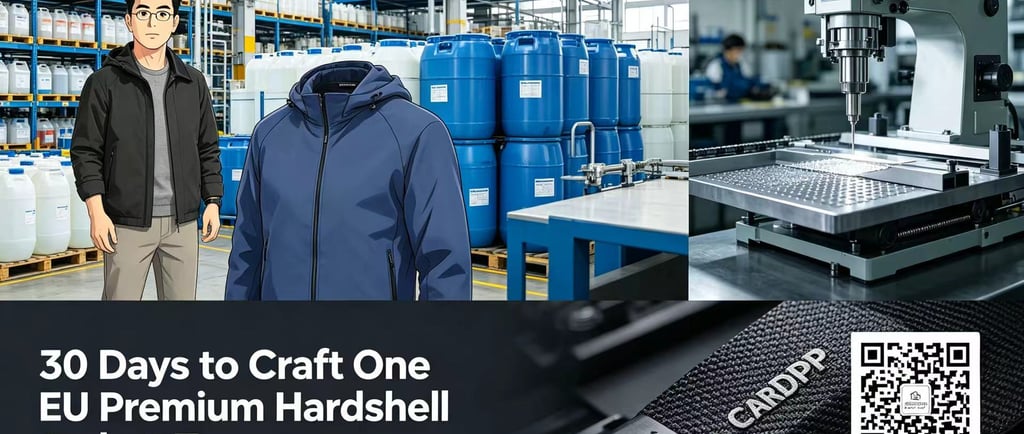
Script: Thirty Days to Craft One EU Premium Hardshell Jacket
Full 30-Chapter Story Drama
Genre: Industrial Technical Narrative / Workplace Coming-of-Age Drama
Characters
1. Don: Fresh graduate, Textile & Apparel Engineering major, new trainee at EverSummit Outdoor Garment Factory (a 28-year heritage hardshell manufacturer)
2. Uncle Fred: Senior Chief Technical Engineer, 22 years of hardshell R&D & production experience, factory technical backbone, Gore TEX certified auditor, industry veteran
3. Supporting Roles: Warehouse Supervisor Lee, Workshop Foreman Tom, Compliance Manager Sara, Brand IP Manager Mia, Lab Tester Zoe
Core Plot Line: Don joins the factory with textbook theoretical knowledge only. Over 30 consecutive working days, Uncle Fred walks him through every single link to produce a high-end alpine hardshell certified for EU market entry, covering fabric weaving, ePE membrane lamination, fluorine-free DWR finishing, ultrasonic seamless craft, chemical warehouse safety, workshop occupational health, EU 2027 ESPR carbon DPP traceability, brand IP confidentiality, full testing, and massive capital & technical investment thresholds. By Day 30, Don fully understands: premium EU hardshell jackets are the most tech-intensive product in the entire textile industry.
Chapter 1 (Day 1): First Day at Ever Summit Factory – The Gap Between Textbook and Reality
Don graduates top of his textile engineering class and reports to Ever Summit, a factory famous for OEM high-end outdoor hardshells for Arc'teryx, Mammut and Mont bell. He carries thick university textbooks full of fabric formulas, feeling confident. HR leads him to the technical department, where Uncle Fred, a grey-haired, calm veteran covered in tiny fabric sample swatches, greets him.
Fred sees Don’s textbooks and smiles faintly: “Your university notes only cover half the story. Today we start a 30-day journey: we will follow one single high-end 3L ePE hardshell order destined for EU retail shelves. Every day we unpack one critical procedure, one hidden risk, one costly compliance rule. After 30 days, you will know why this jacket is the textile industry’s technological ceiling.”
Don is confused—he thought a waterproof jacket was just woven fabric plus a plastic film. Fred takes a Gore TEX Pro fabric swatch and hands it to him: “Let’s start from the very first raw fiber tomorrow.”
Chapter 2 (Day 2): Raw Nylon Yarn – The Foundation of All Wear Resistance
Fred brings Don to the yarn warehouse. Pallets of high-density nylon filament yarns are stacked neatly, separated by denier counts: 40D lightweight, 100D rugged N100p-X for alpine lines.
Fred explains: “Ordinary windbreakers use cheap polyester yarn. EU premium hardshells require virgin nylon long filament. The yarn twist, density and impurity content directly decide final abrasion resistance. If the yarn has oil residues, later DWR finishing and ePE lamination will fail entirely.”
Don remembers his lecture about yarn strength, but Fred adds real factory pain points: “Suppliers sometimes cut corners with recycled mixed yarn; once mixed into production, the whole fabric batch will fail EU abrasion testing and get rejected.” Don realises raw material screening is the first unskippable gate for EU export goods.
Chapter 3 (Day 3): Weaving Workshop – High-Density Woven Base Fabric Production
They step into the weaving plant, dozens of looms humming. Fred points out tight plain-weave structures for hardshell outer fabrics.
“Normal casual fabric uses loose weave to cut cost. Our EU-certified base fabric needs warp & weft density over 380 threads per 10 cm. Tighter weave blocks rainwater penetration before the membrane even functions.”
Don watches loom operators adjust tension parameters precisely. Fred warns: Uneven tension creates fabric thickness inconsistency, which causes uneven hot-pressing during later membrane lamination, leading to delamination defects in mass production. Don learns weaving precision directly impacts the whole garment’s waterproof lifespan.
Chapter 4 (Day 4): Grey Fabric Pre-Treatment – Degreasing Is Non-Negotiable
Today’s lesson focuses on grey fabric pre-treatment. The unprocessed woven fabric carries spinning oil, sizing agents and surface impurities.
Fred guides Don through the desizing, scouring and neutralisation baths: “All oil must be fully removed. Any residual grease will break the bonding layer between ePE membrane and outer fabric. EU auditors will reject batches with incomplete pre-treatment.”
Don asks if skipping partial pre-treatment can save cost. Fred shakes his head: “A single defective fabric roll costs thousands of Euros in raw material loss; EU brands enforce zero tolerance for pre-treatment failures.”
Chapter 5 (Day 5): Introduction to Chemical Auxiliaries – Thousands of Chemicals behind One Jacket
Fred takes Don to the chemical auxiliary sample storage room, lined with dozens of barrels of different liquids and powders: fluorine-free C0 DWR emulsions, lamination adhesives, UV stabilisers, penetrants and defoamers.
“Every functional property of the jacket relies on these chemicals. But these are all hazardous substances with strict storage rules. Today we only identify each chemical; tomorrow we dive into warehouse safety risks that most new engineers ignore.”
Don is shocked—he never learned about mass textile chemical auxiliaries in his university coursework, only basic lab reagents.
Chapter 6 (Day 6): Hazardous Chemical Warehouse – Hidden Pollution & Degradation Risks from Poor Storage
The critical hidden risk chapter, Warehouse Supervisor Lee walks them through the temperature-controlled, partitioned chemical warehouse.
Lee shows Don expired DWR emulsion that split into layers after summer high-temperature storage: “Auxiliaries have a 6–12 month shelf life. No constant temperature, no partition zoning, mixed acidic and alkaline chemicals all trigger disasters.”
Fred elaborates the chain reaction: Degraded chemicals lead to failed DWR water repellency → finished garments exceed EU PFAS/VOC limits → customs detain all cargo, full order recall, millions in losses. Leaking chemicals without collection trenches contaminate soil and water, failing brand supply chain audits.
Don takes detailed notes: Chemical warehouse management is a fatal blind spot many factories overlook.
Chapter 7 (Day 7): Fluorine-Free C0 DWR Finishing – EU PFAS Ban Eliminates All Fluorinated Coatings
They visit the padding & curing production line for DWR treatment. Fred contrasts old C6 fluorinated DWR and current plant-wide C0 fluorine-free formulations, mandatory for EU 2026 PFHxA restrictions.
“Traditional fluorinated DWR delivers great water/oil repellency, but releases persistent PFAS chemicals banned by REACH. All EU-bound hardshells must adopt zero-PFAS fluorine-free finishing now.”
Don observes the strict curing temperature window (150–170°C). Overheating damages nylon fabric tensile strength; under-heating fails to lock the DWR polymer onto fibers, causing fast “wet-out” saturation after a few washes. Fred explains the wet-out phenomenon from the Gore technical document: saturated outer fabric blocks vapour transfer, making wearers feel damp even without water leakage.
Chapter 8 (Day 8): Membrane Material Evolution – ePTFE vs New PFAS-Free ePE Microporous Film
Fred lays three membrane samples on the technical office desk: traditional ePTFE, new ePE, and low-cost PU monolithic film.
He recites the industry transformation logic to Don: ePTFE was the “gold standard” for decades but relies on PFAS manufacturing aids; 2026 EU rules phase it out. ePE is the only sustainable alternative, lighter, PFAS-free, yet requires fully upgraded lamination processes to match ePTFE’s abrasion durability. PU film is cheap but lacks breathability for high-exertion alpine climbing.
Don grasps the core industry shift: material replacement is not a simple swap, but a full overhaul of manufacturing parameters.
Chapter 9 (Day 9): 2L vs 3L Membrane Lamination Technology – Gore TEX Exclusive Certified Standards
Touring the lamination workshop, Fred differentiates two-layer and three-layer composite fabrics.
“3L three-layer lamination (outer nylon + ePE membrane + C-Knit backing) is mandatory for premium EU alpine hardshells like Arc’teryx Alpha SV. 2L two-layer fabric is only for lightweight entry hiking jackets.”
Fred emphasises Gore’s strict certification rules: factories cannot alter lamination temperature, pressure or adhesive formulations without Gore’s official audit approval. Unauthorised parameter changes result in immediate revocation of Gore TEX production qualifications. Don learns brand membrane standards are legally binding.
Chapter 10 (Day 10): C-Knit One-Piece Backing Lamination – Mont bell Exclusive IP Craft
Today’s session covers proprietary brand lamination technology. Fred displays Mont bell Storm Cruiser’s C-Knit integrated lining fabric.
“This knitted backing composite is exclusive Mont bell IP. Ordinary tricot lining creates noisy fabric friction and weak moisture transfer. C-Knit forms a softer, quieter high-breathability structure, only produced in two globally authorised lamination factories.”
Fred explains IP control measures: separate production shifts, encrypted process parameters, no external personnel access to dedicated C-Knit production zones. Don realises brands lock core craft to avoid market counterfeiting.
Chapter 11 (Day 11): Laser Precision Cutting – Micro-Cut Technology for Stress Joints
Moving to the cutting department, Don watches automated laser cutting beds slice composite fabric with ±0.1 mm precision.
Fred points out multi-seam intersection zones (armpits, shoulder joints), the most frequent waterproof failure points. Laser micro-cut eliminates frayed fabric edges, reducing stacked fabric bulk at junctions. Traditional die-cutting creates uneven edges that ruin seam taping tightness.
Premium EU brands mandate laser cutting for all high-stress panels; cheap mass-market jackets skip this process to cut costs. Don notes precision cutting is a visible technical divider between high-end and budget outerwear.
Chapter 12 (Day 12): Traditional Sewing Stitch Basics – Every Needle Hole Creates a Leak Risk
Fred demonstrates standard sewing construction to Don. “No matter how waterproof the fabric is, every needle pierce creates a potential water penetration channel. This is why hardshells cannot rely only on fabric performance—seam sealing is equally critical.”
Don sews a test fabric sample himself, observing tiny pinholes left by the needle. Fred says casual windbreakers ignore full taping, but EU professional hardshells require 100% seam coverage with heat-activated tape.
Chapter 13 (Day 13): Hot-Cold Integrated Seam Taping – New Generation Tapering Craft
The factory’s newly installed hot-cold dual-stage taping machines are the focus today. Fred contrasts old single hot-press equipment: single heat application leaves internal tape stress, leading to peeling after repeated washing. The new integrated line heats to activate adhesive then instantly cools to lock tape flat.
“Arc’teryx and Mammut exclusively require this machine for EU lines. Thin 13 mm micro tape cuts garment weight and boosts breathability, yet demands ultra-precise temperature and speed control; a 0.5°C deviation creates incomplete sealing and leakage defects.”
Don sees stacks of rejected test garments with bubbled, partially detached tape to illustrate the high defect risk of advanced new craft.
Chapter 14 (Day 14): Ultrasonic Seamless Welding – Eliminate Needle Holes Entirely
Today introduces the flagship upgraded craft: ultrasonic seamless fusion for pit zip vents, pocket edges and elastic panel joints. High-frequency vibration melts fabric polymer fibres together with zero stitching holes.
Fred calculates benefits: 15–20% lighter panels, triple higher peel strength than stitched + taped seams, superior low-temperature crack resistance for alpine cold environments.
Limitation reminder: ePE membrane is heat-sensitive, so fusion temperature must stay below 120°C to avoid melting micropores and destroying breathability. Don records this delicate balance between bonding strength and membrane integrity.
Chapter 15 (Day 15): Exclusive Brand IP Craft 1 – Arc’teryx RSTM Seamless Zipper Chamber
IP Manager Mia joins the training today to introduce Arc’teryx’s proprietary RSTM waterproof zipper construction.
Instead of traditional fabric zipper flaps, the zipper base is directly thermally fused to composite fabric, removing extra stacked layers that trap water and trigger wet-out. This patented process runs in a fully enclosed independent workshop with restricted entry, all staff sign strict non-disclosure agreements, leftover cut fabric is crushed and disposed of daily to prevent sample leakage.
Mia warns: If any process parameter leaks to competing factories, the brand will terminate all OEM cooperation permanently. Don fully understands the severity of brand IP protection.
Chapter 16 (Day 16): Exclusive Brand IP Craft 2 – Mammut Reinforced Abrasion Zones & Custom Pit Vents
Fred shows Don Mammut Eiger Nordwand panel samples. Shoulders, elbows and pack contact zones feature double-layer laser-cut reinforcement fabric, with an internal audit standard of 25,000 Martindale abrasion cycles (higher than universal industry 20,000 threshold).
Extra-wide pit zips with double ultrasonic-sealed waterproof flaps serve as active mechanical ventilation. Fred explains passive fabric breathability fails in high humidity or soaked outer fabric; mechanical airflow from pit zips delivers instant cooling no membrane can match. This dual ventilation design is a fixed Mammut custom specification unalterable by manufacturers.
Chapter 17 (Day 17): Workshop Occupational Health Blind Spot – Industry’s Ignored Hidden Hazard
A critical under discussed topic, Safety Officer Amy leads Don through gas detection testing at curing, lamination and taping stations.
DWR curing releases volatile organic compounds; hot melting adhesives emit toxic fumes; fabric trimming generates chemical-laden micro dust. Current global testing rules only audit finished garments, not real-time workshop hazard concentrations.
Amy shows expired air test reports from small competitor factories: unventilated workshops cause chronic respiratory disease and contact dermatitis among workers. Ever Summit installs full exhaust gas collection + activated carbon purification, provides gas masks, chemical-resistant gloves and quarterly occupational health physicals for all frontline staff. EU brand social compliance audits mandate full workshop hazard monitoring data; missing reports result in immediate order cancellation.
Don realises worker safety is not only a moral obligation but a mandatory EU market entry requirement most manufacturers neglect.
Chapter 18 (Day 18): Semi-Finished Product Inspection – Seam Leakage & Membrane Delamination Screening
Lab Tester Zoe walks Don through semi-finished panel inspection. Every taped seam undergoes partial water spray testing to spot invisible micro-leaks.
Common mass-production defects Fred summarises: uneven tape pressure causing partial sealing, fabric oil contamination breaking lamination adhesion, laser cutting burrs tearing ePE thin membrane during assembly.
Defective panels are completely scrapped instead of reworked—EU premium brands prohibit patched or repaired components on retail garments, leading to high raw material waste costs for factories.
Chapter 19 (Day 19): Full Garment Assembly – 3D Helmet-Compatible Hood, Cuff & Hem Waterproof Adjustment
Full garment assembly training covers structural design exclusive to professional alpine hardshells: three-dimensional helmet-compatible hoods with multi-point adjustment, waterproof hook-and-loop cuffs, draw cord hem seal systems to block wind and rain backflow.
Cheap urban windbreakers use flat, non-adjustable hoods that fail in heavy mountain storms. Every adjustment component (waterproof zippers, sealed cord locks) must pass separate EU heavy metal and PFAS screening as auxiliary materials. No single accessory escapes compliance testing.
Chapter 20 (Day 20): Full Garment Rain Chamber Testing – Gore Mandatory 100% All-Round Spray Inspection
Today’s lab session covers the Gore-mandatory rain chamber test, the ultimate waterproof performance check for finished jackets. Every single EU-bound hardshell undergoes continuous simulated heavy rainfall with wind for 30 minutes.
Fred holds up a rejected jacket with tiny seepage at shoulder multi-seam junctions: “Even one pinprick leak means the whole garment is discarded. Zero tolerance defects are written into Gore’s certification contract.”
Test data from every jacket is logged permanently to feed into the EU 2027 Digital Product Passport traceability system later.
Chapter 21 (Day 21): Full-Spectrum Chemical Compliance Testing – PFAS, Heavy Metals, VOC & REACH SVHC
Compliance Manager Sara leads Don through the third-party laboratory testing process for EU customs clearance.
Mandatory test items: EN 17681-1:2025 PFAS detection (total PFAS <250 ppb), formaldehyde, pH value, banned azo dyes, heavy metals, plasticiser phthalates, ZDHC MRSL compliance.
Sara shares real industry cases: Small factories skip full pre-testing; PFAS trace contamination from shared production lines leads to entire container seizures at European ports, tens of thousands of Euros in cargo loss and permanent brand blacklisting. All raw materials, fabrics, auxiliaries and accessories require batch-by-batch chemical screening before production.
Chapter 22 (Day 22): Carbon Footprint PEF Accounting – Preparations for 2027 EU ESPR DPP Rules
The brand’s sustainability team introduces the EU 2027 ESPR Sustainable Products Regulation, the newest major compliance barrier Don never learned in university.
All EU hardshells require full lifecycle PEF carbon footprint calculation (from raw fibre extraction to factory dispatch, “cradle-to-gate”). Every jacket is assigned a unique QR Digital Product Passport (DPP) linking to EU official databases, recording yarn origin, membrane model, chemical auxiliary batches, production workshop records, carbon emissions and test reports.
ePE fluorine-free membrane reduces carbon emissions by 23–39% compared to old ePTFE, becoming a core sustainability advantage for EU market access. Factories must build full digital traceability systems before 2027 enforcement. Don recognises carbon tracking is no longer optional marketing but a legal customs requirement.
Chapter 23 (Day 23): Hazardous Waste & Auxiliary Disposal – Extended Environmental Compliance
Back to chemical warehouse training and covering post-use waste handling. Expired DWR emulsions, leftover solvent adhesives, contaminated fabric trimmings count as hazardous waste and must be collected by licensed environmental agencies.
Fred explains EU supply chain audit rules: incomplete waste disposal records result in audit failure. Many small factories dump chemical waste illegally to cut cost, risking large EU fines and permanent export bans. Ever Summit maintains full waste transfer logs synchronised to the DPP traceability system.
Chapter 24 (Day 24): Brand IP Confidentiality Full-Site Control System
Mia the IP manager consolidates all factory confidentiality protocols for Don’s full understanding:
1. Physically separated closed workshops for proprietary craft (RSTM zipper, C-Knit lamination);
2. Encrypted digital process files, physical paper drawings collected and destroyed daily;
3. All staff sign multi-year non-disclosure agreements with heavy penalty clauses for leakage;
4. All fabric waste, defective samples, prototype garments mechanically crushed instead of discarded.
Counterfeit manufacturers regularly attempt to purchase factory scraps or bribe workers for process parameters. A single leaked craft erases a brand’s multi-million R&D technical advantage. Don realises IP management is a core daily factory operation, not an afterthought.
Chapter 25 (Day 25): Gradient Material Formulation Comparison – Tiered Products for Different Markets
Fred organises all six material formulation schemes on one table for Don’s comparative analysis:
1. Top EU alpine hardshell: N100p-X 3L ePE + C0 fluorine-free DWR + full ultrasonic seamless craft
2. Mid-range EU hiking jacket: 70D stretch nylon 2L domestic ePE + standard fluorine-free DWR
3. Heavy-duty abrasion climbing hardshell: thickened 120D nylon + high-porosity ePE + reinforced abrasion panels
4. Lightweight fast-pack jacket: 40D ultra-thin 3L C-Knit composite fabric
5. Budget city casual jacket: low-cost PU film, partial taping, no seamless craft (unsuitable for extreme alpine use)
6. Domestic-only stock ePTFE + C6 fluorinated DWR (prohibited for EU export after 2026)
Fred summarises the irreversible industry trend: ePE + fluorine-free DWR is the only long-term EU-compliant formula. All other combinations face regulatory phase-out.
Chapter 26 (Day 26): Full Factory Capital Investment Breakdown – The High Cost of Premium EU Hardshell Production
Fred pulls out a factory investment spreadsheet to show Don the complete financial threshold:
1. Hardware equipment: High-density looms, fluorine-free finishing lines, 3L lamination machines, hot-cold taping, ultrasonic welders, laser cutters, rain test chambers, PFAS labs – over USD 400,000 upfront fixed investment.
2. Safety & environmental infrastructure: Constant-temperature chemical warehouses, workshop exhaust purification, waste disposal systems, carbon traceability digital hardware – additional USD 70,000+.
3. Recurring annual costs: Material R&D testing, quarterly chemical & occupational health testing, Gore annual recertification, brand social audits, DPP system operation, waste treatment fees – tens of thousands USD sustained expenditure every year.
Compare with ordinary casual windbreaker factories requiring only basic sewing machines with minimal environmental investment: premium hardshell production demands 5–10 times higher total capital input. Don finally grasps the massive financial barrier separating high-end technical outerwear from mass-market apparel.
Chapter 27 (Day 27): Three Tiers of Industry Pain Points – Industry, Factory & Market Dilemmas
Fred leads a full review of the entire industrial chain’s three core pain categories, summarising all hidden risks Don encountered over the past 26 days:
1. Cross-industry pain points: Monopolised high-end ePE membrane supply driving raw material cost inflation; rapid EU regulatory updates forcing continuous production line renovation; widespread craft counterfeiting causing severe market homogenisation.
2. Factory production pain points: Expensive new craft equipment upgrades; high defect rates for precision ultrasonic/taping processes; chemical warehouse management manpower costs; neglected occupational health infrastructure creating hidden audit risks; ePE membrane mass-production durability defects hard to resolve.
3. End-market pain points: Consumers lack awareness of fluorine-free eco-performance and resist price premiums; mid-small brands cannot afford EU compliance costs and lose European market share; homogenised product design creates vicious price competition.
Fred explains the industry’s only sustainable solution: domestic ePE membrane substitution, tiered product formulation development, and exclusive proprietary brand craft to build non-replicable technical barriers.
Chapter 28 (Day 28): Integrated Optimisation Solutions for All Hidden Risks
Today consolidates all mitigation strategies for every hazard Don learned throughout the training:
1. Chemical warehouse risk fixes: Partitioned constant-temperature storage, strict first-in-first-out shelf-life management, leakage containment and emergency response drills;
2. Workshop occupational health fixes: Full exhaust gas purification, station-specific protective equipment, quarterly hazard testing and annual worker physicals;
3. EU regulatory compliance fixes: Full raw material pre-screening, physical separation of fluorinated/fluorine-free production lines, pre-built DPP carbon traceability systems;
4. IP leakage risk fixes: Closed dedicated workshops, encrypted process documents, scrap destruction and legal non-disclosure contracts;
5. ePE membrane durability weaknesses: Optimised lamination adhesive formulations, heavier denier outer fabric reinforcement, improved fluorine-free DWR curing parameters.
Don compiles all solutions into a complete technical manual for future reference.
Chapter 29 (Day 29): Finished Garment Packing, DPP QR Code Labelling & EU Export Documentation
The final production stage before cargo ships to Europe. Each jacket is tagged with a unique NFC QR code linked to the EU DPP digital passport, embedding all full-lifecycle traceability data collected over the 29 prior days.
Sara the compliance manager assembles all mandatory export documentation: PFAS test certificates, PEF carbon footprint reports, Gore factory certification credentials, occupational health workshop audit records, hazardous waste disposal logs, brand IP production approval files. Missing any single document leads to customs detention at European ports.
Don holds a completed premium hardshell jacket in his hands, tracing every seam, fabric panel and zipper, recalling every single production step, chemical risk, regulatory rule and technical parameter Uncle Fred taught him day by day.
Chapter 30 (Day 30): Closing Summary – The Hardshell Jacket Is the Textile Industry’s Technological Peak
Thirty days of training concludes. Don sits in Fred’s technical office with all his filled notebooks spread across the table.
Fred looks at the finished EU-certified hardshell jacket between them and delivers the core concluding lesson:
“Ordinary fashion clothes, casual windbreakers and basic sportswear only require simple weaving and stitching, with no multi-layer membrane lamination, precision taping equipment, PFAS full testing, carbon footprint traceability, hazardous chemical storage rules or workshop occupational health controls. This single high-end EU hardshell integrates polymer chemistry, precision thermal engineering, extreme weather textile mechanics, cross-border EU environmental law, industrial safety and full digital traceability – six intersecting complex disciplines.
Every link demands heavy capital investment, continuous technical R&D, rigorous end-to-end management and strict IP protection. Any minor misstep in yarn, weaving, chemical finishing, membrane lamination, sewing, taping, testing, warehouse safety or compliance will invalidate the entire garment.
After these 30 days, you now understand the definitive truth: within the entire textile and garment manufacturing industry, professional waterproof hardshell jackets are the product with the highest comprehensive technical difficulty, equipment investment, chemical material barriers, global regulatory compliance requirements, workplace safety standards and intellectual property management obligations. This jacket is the undisputed technological ceiling of our industry.”
Don closes his notebooks, full of new insight. He leaves the factory ready to apply his 30 days of real-world industrial experience, no longer only relying on textbook theory. The story of one EU premium hardshell jacket, told across thirty days, completes.